
The Manguebyte ecosystem
Parabolic
Build your own audio plugins and samplers without writing code: you shape a sound with the controls a musician already knows and press one button to get a real plugin.
In development. There is no version to download yet, and the code is not public yet.

What it is
Parabolic is a plugin and sampler generator for musicians. You shape a sound with the controls you already know (samples, oscillators, filters, envelopes, effects, a keyboard) and press one button to get a real plugin, in CLAP or VST 3.
Tools that turn ideas into plugins already exist, but each asks the musician to become something else first: a patcher, a programmer, or a customer of someone else's player. Parabolic speaks the musician's language.
The name comes from Recife's manguebeat, whose symbol is a satellite dish planted in the mud of the mangrove, pulling signals from the world and sending the mangue's back out. Parabolic is that dish for sound: it receives what a musician imagines and transmits it as a plugin anyone can open.
What you can do
- Sampler
- Import your samples: the program maps them across the keyboard, and you set start, end and loop on the waveform, with volume, attack and release.
- Synthesiser
- A layer together with the sampler: oscillators, with a wavetable and unison on the first, a sub and noise, a filter and envelopes.
- Effects
- A chain of effects you build and reorder, each with its own panel.
- Drums
- A grid of the 16 main pieces of the General MIDI map and any other key the kit uses: drop a sample on a pad and set its level, pan and tuning.
- Presets
- Ready sounds by category to start from. Your own stay in My sounds, with every control, and serve in every project.
- Export
- Give a name, a maker, a version and a description and choose CLAP, VST 3 or SFZ, with no compiler on your machine and checks before it exports. The plugin has a panel of its own, made without programming, with the controls in use, an output meter and a light or dark theme. For now, on 64-bit Windows only. SFZ carries the samples, the map, the tuning, the gain and the loops, without effects or the synthesiser.
The screens
Captures of the program as it is today, made by the program itself. The interface exists in English, Portuguese and Spanish, in a light and a dark mode.
-
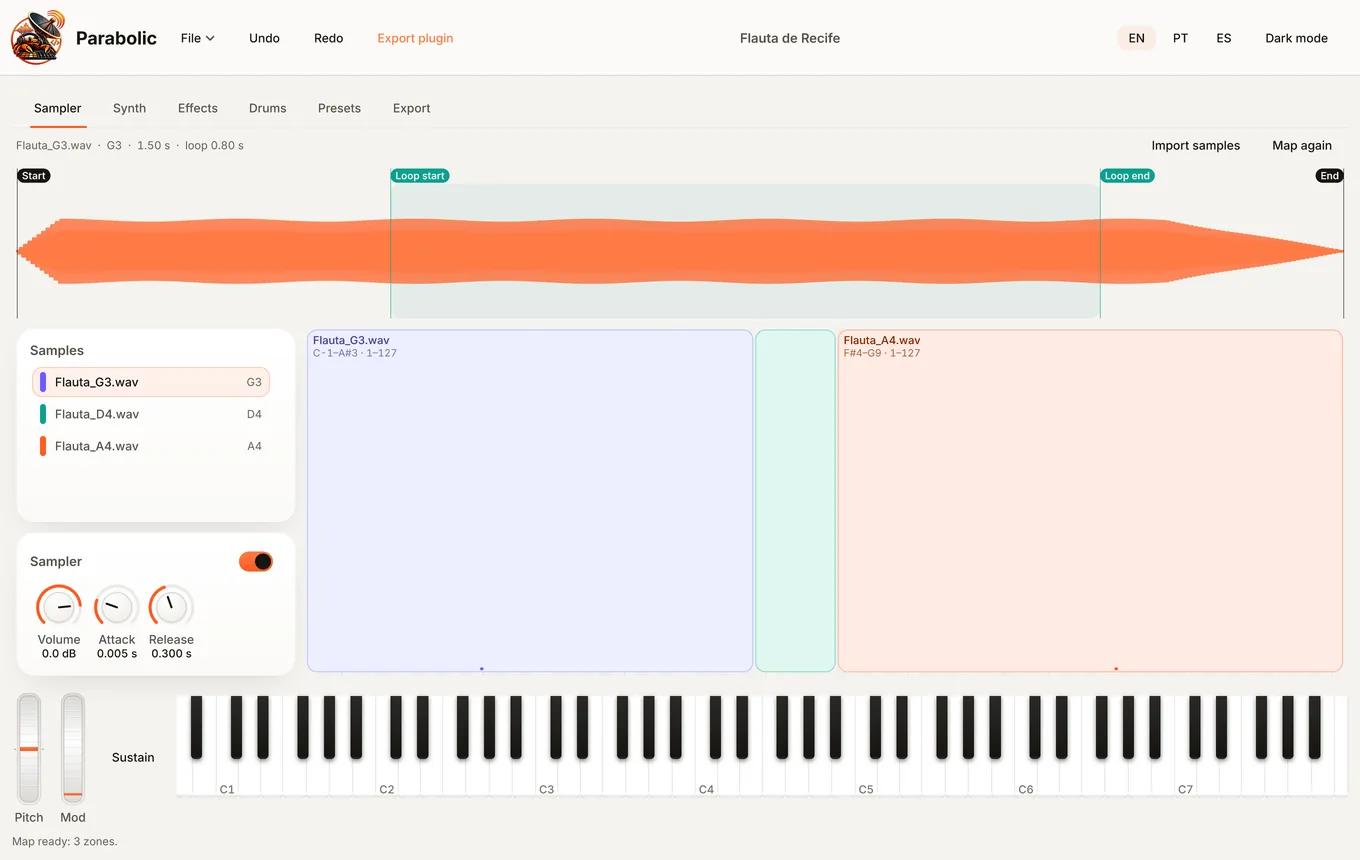
Sampler: the samples, the loop and the key map -
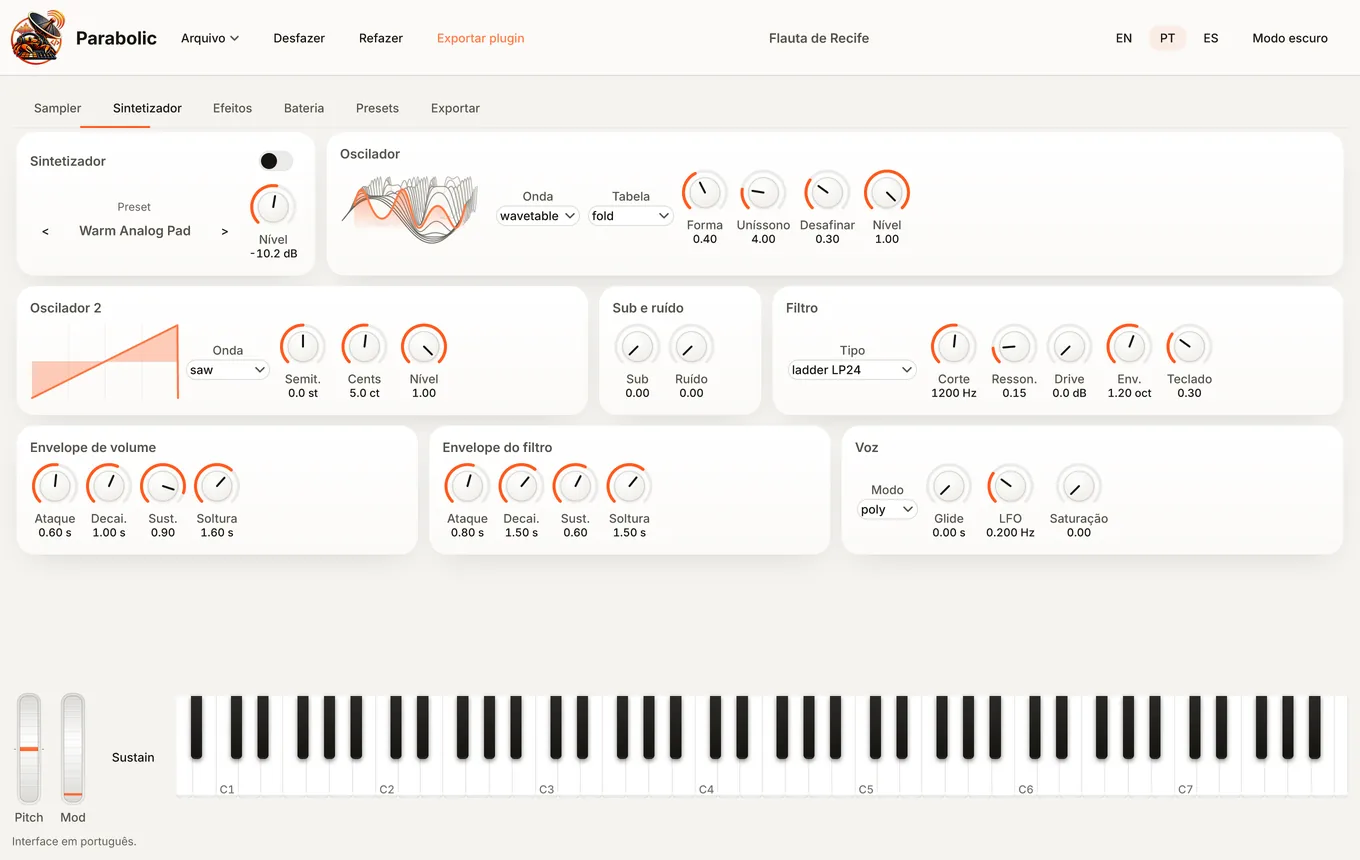
Synthesiser -
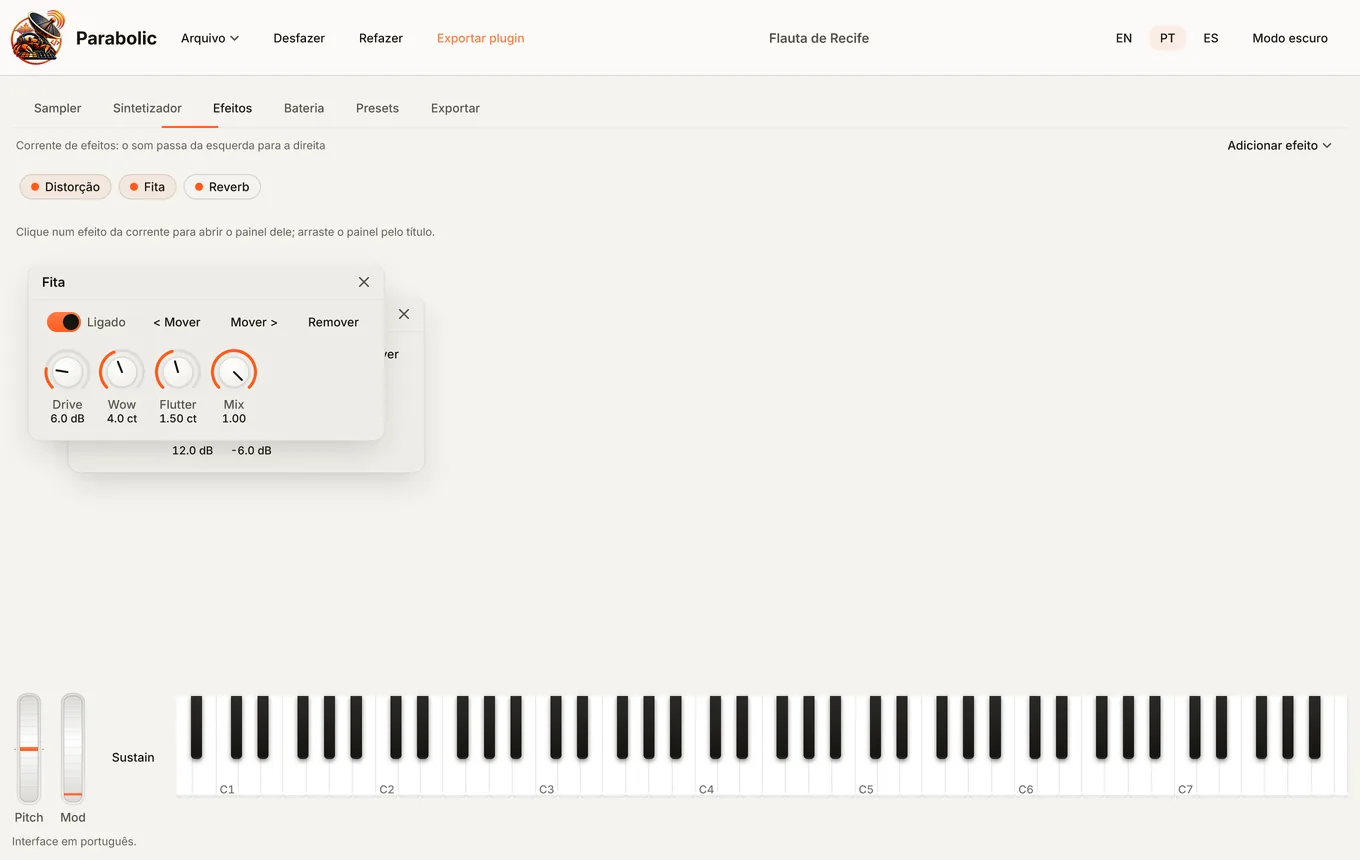
Effects -
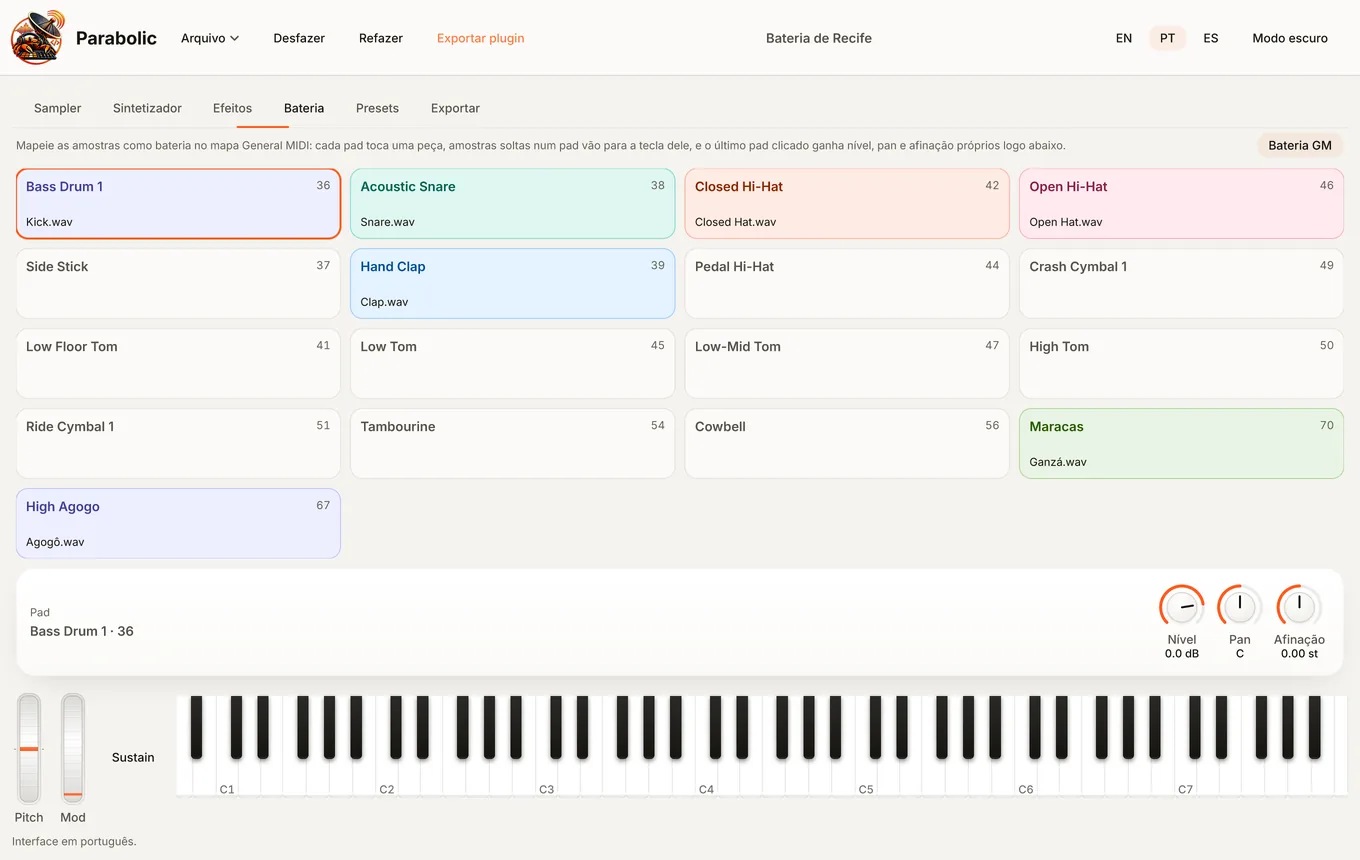
Drums: one pad for each piece -
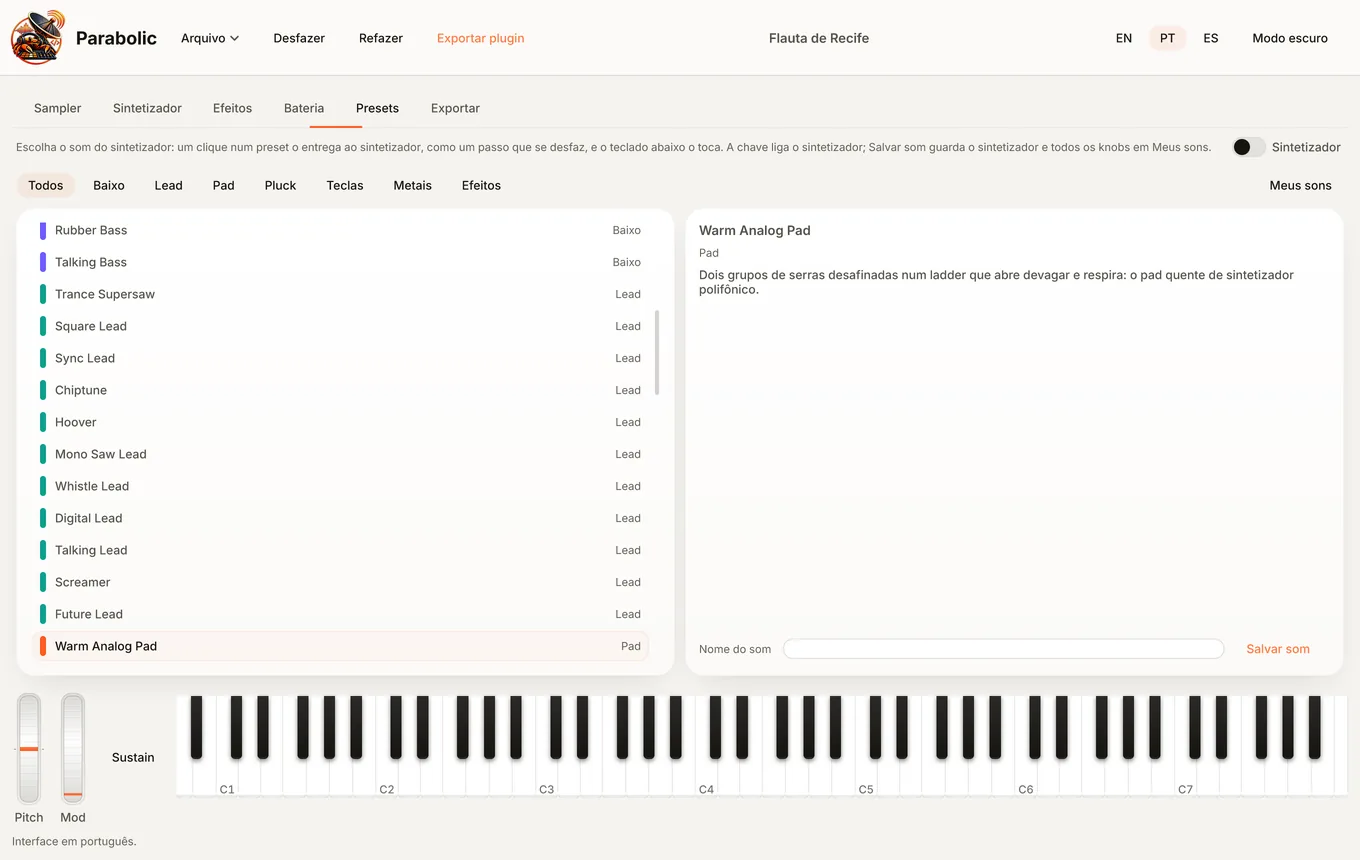
Presets -
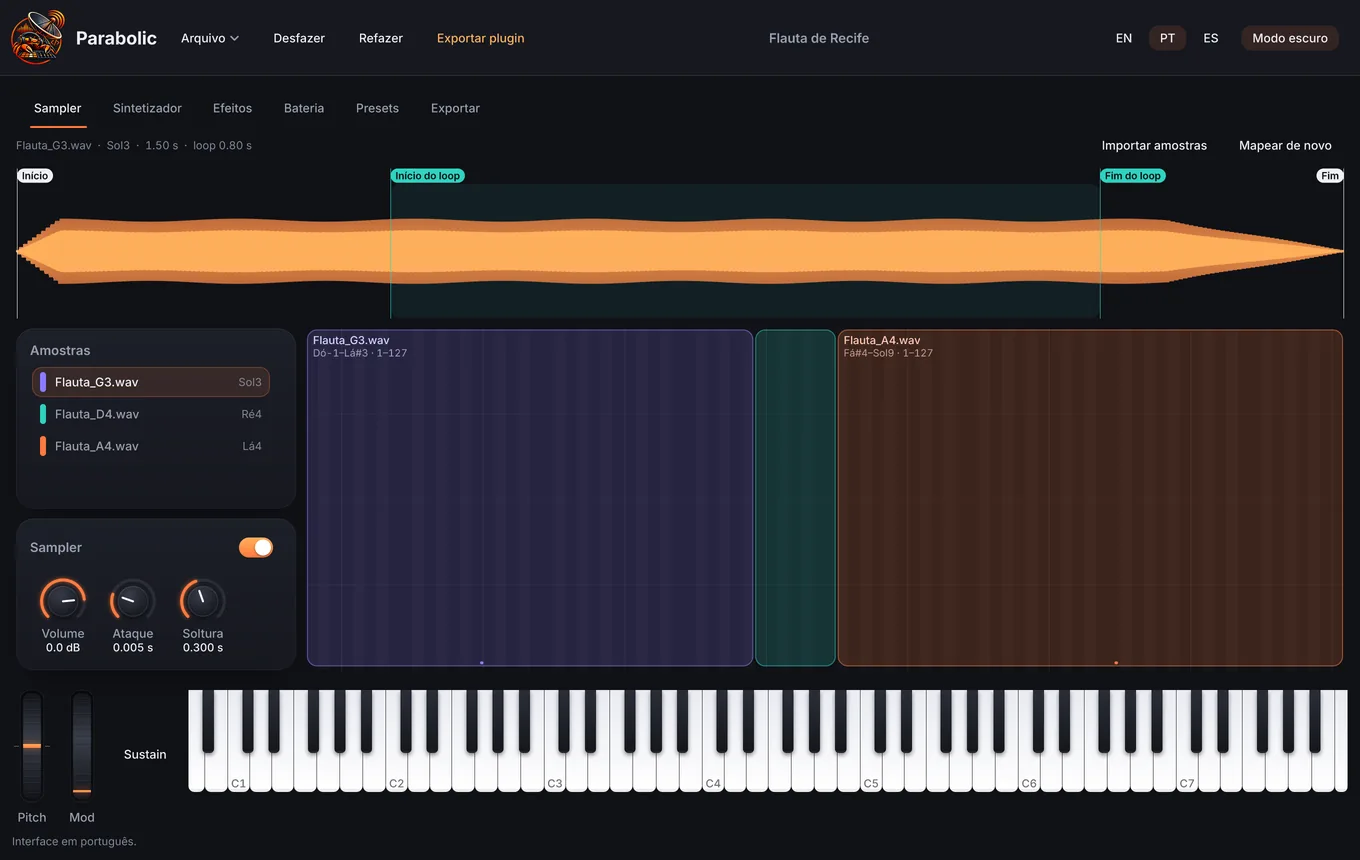
The dark mode
How it works
A project is a folder: a text document with everything you did, with undo and redo, and the sample files, which are never changed. Before it is heard, a project is compiled into a frozen description of what to play.
The preview inside Parabolic and the exported plugin play that same description, on the same engine. Exporting compiles nothing: a plugin is a ready-made engine with your instrument appended to it, which is why it needs no compiler on the machine of whoever makes it.
How it uses Manguebyte
Parabolic is built entirely on Manguebyte: the sampler and the sound come from manguebyte-sampler and manguebyte-dsp, the plugins from manguebyte-clap and manguebyte-vst3, the samples from manguebyte-formats and manguebyte-analysis, the projects from manguebyte-state, and what you see from manguebyte-ui and manguebyte-gui.
With that it inherits the framework's rules: nothing on the audio thread allocates memory, locks, waits or panics. What Parabolic lacks is asked of the framework and built there, in the open.
Licence
Parabolic will be free for personal, educational and research use, under the PolyForm Noncommercial 1.0.0. Commercial use, including selling plugins made with it, needs a commercial licence. Manguebyte stays under MIT or Apache-2.0.
The Manguebyte ecosystem
Four more projects from Recife grow from the same mangue, built to run on Manguebyte.
-

This framework
Manguebyte
The open-source audio framework for Rust, under MIT or Apache-2.0, released on crates.io. Aratu already plays on its browser engine, and its Aratu Bridge plugin plays the same music in a DAW; Caecilia and Parabolic are built on it.
-

In development
Aratu
A live-coding language that reads like music: measures, beats and note values first, in Portuguese, Spanish and English. Its editor runs in the browser and plays on Manguebyte.
-

Alpha
Caecilia
A virtual pipe organ written in Rust on Manguebyte: a program of its own and VST3 and CLAP plugins.
-
In development
Parabolic
A tool for musicians to turn their own sounds into plugins and samplers without writing code.
-
In design
MARÉ
Multi-device Audio Realtime Exchange: an open protocol for low-latency audio and MIDI, to replace ASIO. Many programs on one device at once, many devices as one, MIDI 2.0 on the same clock.